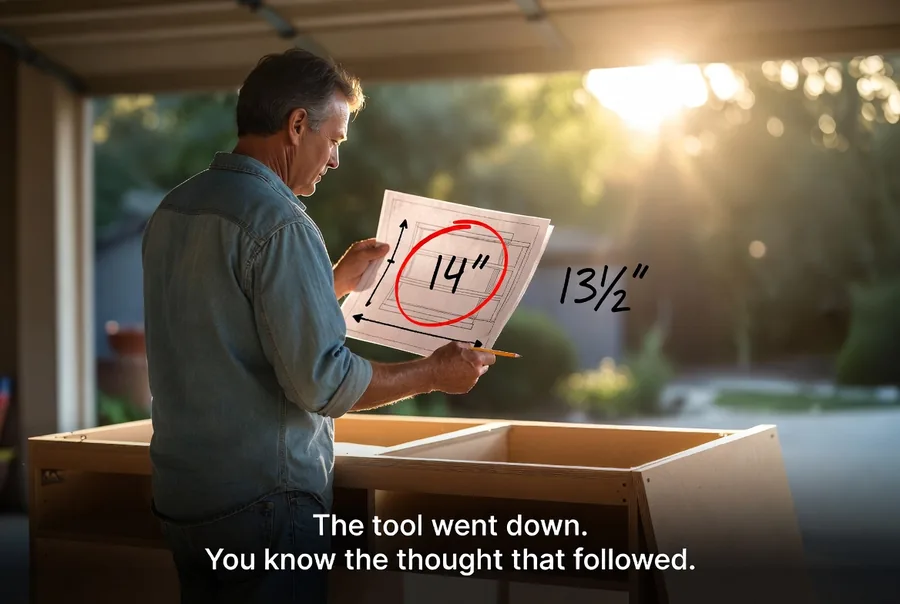
The plan said 14". The wood said 13½". Ted went home that night and rewrote every step from scratch.
You can replace the wood.
You drive back to the lumber yard, you buy it again, the money is gone but it's replaceable.
That's not the part that tends to keep people from going back to the garage.
What keeps people away is the Saturday.
The drive home.
The quiet decision — made without words, almost without noticing — that this probably just isn't for you.
That thought costs more than any piece of lumber. And a bad plan is often what puts it there.
The plan said 14". The wood said 13½". Ted went home that night and rewrote every step from scratch.
A Saturday morning in New Jersey. Eight men cleared their weekends for a workshop class.
They drove in. Set up at the benches. They had the plan — Popular Woodworking magazine, professional layout, clean photos, exactly the kind of thing that makes you feel like this time it's going to work.
Steps one through five — everything moves. Sawdust. Momentum. The satisfying feeling of a morning going the way it was supposed to.
Then step 6.
The retiree at the back picks up his side panel. Wrong size. He checks his measurements — correct. He checks his cuts — correct. He goes back to the materials list. He bought exactly what it specified.
Everything he did was right.

Everything he did was right. The plan was wrong. He had no way to know the difference.
The plan had used nominal lumber dimensions — the number printed on the tag at the hardware store. Not the actual milled size of the wood sitting on his bench. A fraction of an inch. Invisible. Not mentioned anywhere in the instructions. Every cut he'd made that morning was now wrong.
The contractor two rows in had caught it by instinct — years of experience meant he'd adjusted without thinking. But the retiree had no way to know that. And now his whole morning was on the floor.
He didn't just lose the wood. He lost the Saturday he'd set aside. The momentum that had been building since step 1. And on the drive home, something quieter — the belief that this was something he could actually do.
The instructor that morning was Ted McGrath. Educator, trainer, author, member of the Architectural Woodwork Institute.

Ted McGrath has watched the same sequence play out across 4,000 students. The failed step. The frustration. The person who stops coming on Saturday mornings. He decided to fix the plan instead.
He had watched this same sequence play out across 4,000 students. The failed step. The frustration. The person who used to come on Saturday mornings stopping coming on Saturday mornings.
That night Ted took the plan home. Built the cabinet himself from scratch. Wrote every real dimension down as he measured it at the bench. Found every step that assumed knowledge the plan never gave. Fixed them all.
The following week the retiree came back. He finished the project. He came back the week after that too.
A plan that works doesn't just produce a cabinet. It produces a woodworker who shows up again.
That's what Ted set out to build. Here's what came from it.
After that Saturday, Ted started over. One plan became ten. Ten became fifty.
He hired woodworkers who could build and write. A twelve-person team, five new plans every week, fifty weeks a year, for over two decades. Every plan built at the bench before it was written. Every dimension written from the bench, not the store label. Every step that could fail identified before the plan reached anyone who had cleared a Saturday for it.
16,000 plans. Every one built by someone who wanted to make sure you'd come back next weekend.
More than 54,000 woodworkers have used them. Over 173,000 projects completed.

These are not estimates. They are the count of woodworkers who stopped blaming themselves and started finishing what they started.
Many plans show you what the finished piece looks like. What they don't show you is what happens when you try to follow them at a real bench with real lumber. They know what it should look like. They've drawn the lines and labelled the parts. What they haven't done is stand at a bench with real lumber and find out where the plan stops being accurate.
Here is where Ted's plans are different, specifically.
Every plan includes actual milled dimensions — not nominal sizes. The number on the tag at the store is not the number you cut to. A 2×4 measures 1½" × 3½" off the shelf. Ted's plans give you the real number. The one that means your cuts will fit.

Every dimension on every plan is the number you actually cut to. Not the tag at the store. The real size of the wood in your hands.
Every plan includes the assembly sequence written from the bench. Not the order that looked clean on paper — the order that works when you're standing there with the pieces in your hands. The step where many plans go quiet is the step Ted's plans are most careful about.
Every plan includes a complete cut list that prints on a single sheet. It goes in your pocket when you drive to the lumber yard. One trip, not three.
Every plan includes full hardware specs — exact fasteners, joinery methods, what goes where. No guessing at the hardware store because the plan forgot to mention something.
The step that trips you up is always the step the plan quietly left out. Ted's plans are built to make sure that step is there.

"Best plan collection I've reviewed in 20 years of editing. I've evaluated dozens of plan packages for our publication. Most are padded with filler. Ted's plans are consistently detailed — real cut lists, real dimensions, real assembly order. This is the one I recommend to readers who ask."
— Willie Stark, Chief Editor, Valdosta ★★★★★

"I've bought two other plan bundles before. Never built a thing from either one. Found a storage bench plan in Ted's library, had the lumber list in my hand within five minutes, and finished the build in three weekends. It's on my front porch right now."
— David Tomczak, Atlanta GA ★★★★★

"Bought the exact lumber on the materials list. Every piece fit. No extra trips to the store. That's never happened to me before with downloaded plans."
— Oliver Whitfield, Birmingham UK ★★★★★
The collection is 16,000 plans. Every one tested at a real bench before it reached yours. $67, one payment, no subscription.
Every purchase is backed by a 60-day money-back guarantee through ClickBank. If the plans don't work at your bench, you get your money back.

This is what the Saturday was always supposed to produce. The project. And the man who finished it.
You're in your garage. The plan is open in front of you. You hit the step where you'd normally put the tool down.
This time the plan doesn't go quiet. The cut order is there. The dimensions are real. The sequence is written by someone who stood exactly where you're standing and figured it out before you had to.
You keep going.
The lumber was always replaceable. Ted spent 25 years protecting the Saturday.
$67. One payment. 60-day guarantee. The one-time price is available now — the sales page will show you the current deadline.